
Article Plan: Congruence and Similarity Worksheet with Answers PDF (as of 04/07/2026)
This comprehensive guide details worksheets aiding geometry students, focusing on congruence and similarity concepts,
with readily available answer keys from platforms like airSlate SignNow, DocHub, and JustMaths.co.uk.
Worksheets are vital tools for mastering geometric relationships, specifically congruence and similarity, offering practice
problems and assessments, often accompanied by answer keys for self-checking and improved understanding of these core concepts.
What are Congruence and Similarity Worksheets?
Congruence and similarity worksheets are educational resources designed to reinforce understanding of fundamental geometric principles. These worksheets, often available in PDF format, present students with a variety of problems centered around identifying congruent and similar shapes. They typically involve tasks like determining corresponding sides and angles, calculating ratios, and applying congruence postulates (SSS, SAS, ASA, AAS) or similarity theorems (AA, SSS, SAS).
Resources like airSlate SignNow and DocHub offer readily accessible worksheets, while platforms such as JustMaths.co.uk provide structured exercises, including proofs like demonstrating triangle congruence. These worksheets aren’t merely problem sets; they are tools for developing logical reasoning and spatial visualization skills. The inclusion of answer keys, as highlighted in various sources, allows for independent practice and self-assessment, crucial for solidifying comprehension.
Importance of Understanding Congruence and Similarity
A firm grasp of congruence and similarity is foundational to success in geometry and beyond. These concepts aren’t isolated to textbook problems; they underpin real-world applications in fields like architecture, engineering, and design; Understanding these principles allows for the analysis of shapes, scale drawings, and transformations.
Worksheets, particularly those with answer keys from resources like Study.com, airSlate SignNow, and JustMaths.co.uk, are vital for building this understanding. They provide targeted practice, enabling students to identify congruent and similar figures, calculate missing dimensions, and prove geometric relationships. Mastering these skills fosters critical thinking and problem-solving abilities, essential not only for academic pursuits but also for navigating spatial reasoning challenges in everyday life.
Defining Congruence
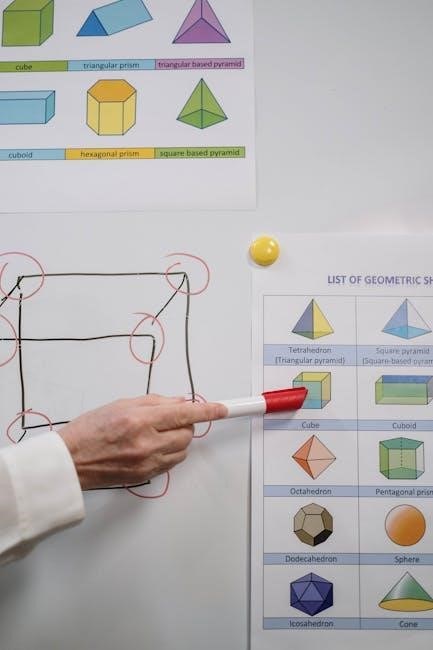
Congruence signifies identical shape and size; worksheets help students pinpoint these exact matches in geometric figures, utilizing postulates like SSS, SAS, and ASA.
Congruent Shapes: A Detailed Explanation
Congruent shapes are fundamentally identical – possessing the exact same size and shape. Imagine creating a perfect copy of a triangle; that copy would be congruent to the original. Worksheets focusing on congruence require students to determine if figures match these criteria. This isn’t simply visual; it demands a logical application of congruence postulates.
These postulates – Side-Side-Side (SSS), Side-Angle-Side (SAS), Angle-Side-Angle (ASA), and Angle-Angle-Side (AAS) – provide the rules for proving congruence. For example, if three sides of one triangle are equal in length to the three sides of another (SSS), the triangles are congruent. Worksheets present diagrams where students must identify corresponding sides and angles, then apply these postulates to demonstrate congruence.
Understanding congruence is crucial as it forms the basis for more complex geometric proofs and problem-solving. Resources like those found on DocHub and JustMaths.co.uk offer varied exercises to solidify this understanding.
Congruence Postulates (SSS, SAS, ASA, AAS)
Congruence postulates are the cornerstones of proving that geometric figures are identical. SSS (Side-Side-Side) states that if three sides of one triangle are congruent to three sides of another, the triangles are congruent. SAS (Side-Angle-Side) requires two sides and the included angle to be congruent.
ASA (Angle-Side-Angle) necessitates two angles and the included side to match, while AAS (Angle-Angle-Side) demands two angles and a non-included side to be congruent. Worksheets heavily utilize these postulates, presenting students with diagrams and requiring them to identify sufficient information to prove congruence.
Many congruence and similarity worksheets, available via platforms like airSlate SignNow and JustMaths.co.uk, challenge students to select the correct postulate based on given information. Mastering these postulates is vital for tackling more advanced geometry problems and building a strong foundation in logical reasoning.
Identifying Congruent Triangles in Worksheets
Worksheets dedicated to congruent triangles commonly present diagrams featuring pairs or sets of triangles. Students are tasked with determining if the triangles are congruent, and if so, stating the congruence using proper notation (e.g., ΔABC ≅ ΔDEF). A key skill is recognizing corresponding sides and angles.
Problems often require applying the congruence postulates (SSS, SAS, ASA, AAS) to justify the congruence. Some worksheets provide side lengths and angle measures, while others require students to deduce this information from diagrams utilizing properties of parallel lines or angle relationships.
Resources like DocHub and Study.com offer numerous examples. These worksheets frequently include questions asking students to write congruence statements or select the correct postulate used to prove congruence, reinforcing their understanding of these fundamental geometric concepts.

Defining Similarity
Worksheets explore similarity, where shapes have the same form but differing sizes, utilizing ratios and proportions to establish relationships between corresponding sides and angles.
Similar Shapes: A Detailed Explanation
Similar shapes are central to understanding geometric relationships, differing from congruent shapes by allowing for variations in size.
These shapes maintain the same form, meaning corresponding angles are equal, and the ratios of corresponding sides are proportional.
Worksheets focusing on similarity often present diagrams requiring students to identify these proportional relationships and calculate missing side lengths.
The concept of similarity ratio is crucial; it represents the factor by which one shape is scaled to create another.
For example, if two triangles are similar with a ratio of 2:1, each side of the larger triangle is twice the length of the corresponding side in the smaller triangle.
These worksheets frequently involve setting up and solving proportions to determine unknown measurements.
Understanding similarity is vital as it extends beyond basic shapes, applying to real-world scenarios like scale drawings and map reading,
where proportional relationships are used to represent larger objects or areas on a smaller scale. Resources like Study.com offer quizzes to reinforce this understanding.
Similarity Ratio and Proportion
Similarity ratio is the cornerstone of understanding similar shapes, representing the scaling factor between corresponding sides. Worksheets emphasize calculating this ratio by dividing the length of a side in one shape by its corresponding side in the similar shape. This ratio remains constant throughout the figures.
Proportion is directly linked, expressed as an equation stating the equality of two ratios. Students practice setting up proportions to find unknown side lengths in similar figures. For instance, if triangle ABC is similar to triangle DEF, then AB/DE = BC/EF = CA/FD.
These worksheets often present problems requiring cross-multiplication to solve for ‘x’, the unknown length. Platforms like JustMaths.co.uk provide examples demonstrating this process; Mastering these skills is essential for applying similarity to real-world problems, such as scale drawings and map interpretations, as highlighted by resources like DocHub.
AA, SSS, and SAS Similarity Theorems
Similarity theorems provide the rules to formally prove that two triangles are similar, avoiding the need to check all angles and sides. Angle-Angle (AA) Similarity states that if two angles of one triangle are congruent to two angles of another, the triangles are similar;
Side-Side-Side (SSS) Similarity asserts that if the three sides of one triangle are proportional to the three sides of another, the triangles are similar. Side-Angle-Side (SAS) Similarity dictates that if two sides of one triangle are proportional to two sides of another, and the included angles are congruent, the triangles are similar.
Worksheets, often found on platforms like Study.com, present diagrams and data requiring students to apply these theorems. Answer keys, such as those available through airSlate SignNow, verify correct application. Understanding these theorems is crucial for solving complex geometric problems and proving similarity.
Types of Problems in Worksheets
Worksheets commonly feature identifying figures, calculating missing lengths/angles, and proving congruence/similarity using postulates and theorems, with answer keys for verification.
Identifying Congruent/Similar Figures
A core skill developed through worksheets involves discerning whether geometric shapes are congruent or similar. Congruent figures possess identical size and shape – all corresponding sides and angles are equal. Worksheets present various polygons and triangles, requiring students to meticulously compare measurements.
Similarity, conversely, focuses on shape, allowing for size differences. Similar figures have proportional corresponding sides and equal corresponding angles. Problems often involve diagrams where students must determine if ratios of sides are consistent, indicating similarity.
These exercises frequently utilize markings to denote equal sides or angles, but students must also learn to identify congruence/similarity without such aids. Resources like those found on DocHub and JustMaths.co.uk provide diverse examples, building confidence in visual recognition and analytical skills. Answer keys facilitate self-checking and error correction.
Finding Missing Side Lengths/Angles
Worksheets dedicated to this skill build upon the foundational understanding of congruence and similarity. If triangles are proven congruent (SSS, SAS, ASA, AAS), corresponding sides and angles are known to be equal, allowing students to calculate missing values.
For similar figures, the concept of proportionality is key. Students utilize established ratios between corresponding sides to determine unknown lengths. Angle measures remain equal in similar shapes, providing another avenue for calculation.
Problems often present diagrams with algebraic expressions representing side lengths or angle measures. Solving these requires applying geometric principles and algebraic manipulation. Platforms like airSlate SignNow and Study.com offer practice problems with detailed solutions, aiding comprehension and skill development. Accurate answer keys are crucial for verifying calculations.
Proving Triangle Congruence/Similarity
Worksheets focusing on proofs challenge students to logically demonstrate congruence or similarity. This involves identifying corresponding sides and angles, and then applying the appropriate postulates or theorems (SSS, SAS, ASA, AAS for congruence; AA, SSS, SAS for similarity).
Students must construct two-column proofs or paragraph proofs, providing statements and justifications for each step. JustMaths.co.uk provides examples of proofs involving congruent triangles within more complex geometric figures, like trapezoids.
A strong understanding of definitions and theorems is essential. Worksheets often require students to explain why a specific postulate or theorem applies. Answer keys, available through DocHub and other resources, offer model proofs for comparison and self-assessment, reinforcing logical reasoning skills.

Utilizing Worksheets with Answer Keys
Answer keys empower self-assessment, allowing students to verify solutions and pinpoint areas needing improvement, fostering independent learning and error analysis skills.
Benefits of Using Answer Keys
Immediate feedback is a cornerstone of effective learning, and answer keys provide precisely that for congruence and similarity worksheets. Students can instantly check their work, reinforcing correct understandings and quickly identifying misconceptions. This self-checking process promotes independent learning and reduces reliance on constant teacher intervention.
Furthermore, answer keys aren’t simply about getting the ‘right’ answer; they’re valuable tools for understanding the solution process. By comparing their approach to the provided solution, students can analyze their steps, identify errors in logic or calculation, and refine their problem-solving strategies.
Resources like those found on DocHub and JustMaths.co.uk often include detailed answer explanations, going beyond a simple numerical answer to demonstrate the underlying geometric principles. This deeper level of understanding is crucial for building a solid foundation in geometry and tackling more complex problems later on. Ultimately, utilizing answer keys transforms worksheets from a passive exercise into an active learning experience.
Self-Assessment and Error Analysis
Worksheets with answer keys empower students to become active participants in their own learning journey through self-assessment. Comparing completed work against the provided solutions isn’t merely about marking answers correct or incorrect; it’s about critically evaluating one’s own understanding of congruence and similarity concepts.
Error analysis becomes a powerful tool. Students can pinpoint specific areas of weakness – perhaps a misunderstanding of the SSS postulate or difficulty applying similarity ratios. Identifying these errors allows for targeted review and focused practice.
Platforms like Study.com offer quizzes alongside worksheets, further enhancing this process. By analyzing patterns in their mistakes, students can develop strategies to avoid repeating them. This iterative process of self-assessment and error correction fosters a deeper, more lasting comprehension of geometric principles, moving beyond rote memorization towards genuine understanding.

Advanced Concepts & Worksheet Applications
Worksheets extend beyond basic proofs, exploring transformations, scale drawings, and real-world applications of congruence and similarity principles, deepening geometric understanding.
Congruence and Transformations (Translations, Rotations, Reflections)
Worksheets frequently integrate congruence with geometric transformations – translations, rotations, and reflections – to demonstrate that these movements preserve shape and size. Students apply congruence postulates (SSS, SAS, ASA, AAS) to prove that figures are congruent after undergoing these transformations.
Problems often require students to identify the transformation applied, then verify congruence. For example, a worksheet might present a triangle and its image after a rotation, asking students to write a congruence statement and justify it using a postulate.
These exercises reinforce the idea that congruent figures have identical corresponding parts, regardless of their orientation or position. Resources like DocHub and airSlate SignNow provide worksheets specifically designed to assess this understanding, often including diagrams for students to manipulate and analyze. Mastering this connection is crucial for advanced geometric concepts.
Similarity and Scale Drawings
Worksheets dedicated to similarity often feature scale drawings, challenging students to apply the concept of proportional reasoning. These problems require calculating missing side lengths in similar figures using established ratios. Students learn to identify corresponding sides and set up proportions to solve for unknowns.
A common worksheet task involves enlarging or reducing an image using a given scale factor. This reinforces the understanding that similar figures have the same shape but different sizes. Resources like JustMaths.co.uk offer exercises specifically focused on similarity and scale, including practical applications.
Furthermore, worksheets may ask students to determine if two figures are similar by verifying that corresponding angles are congruent and corresponding sides are proportional. Platforms like DocHub provide templates for creating and completing these types of problems.
Applying Congruence/Similarity to Real-World Problems
Congruence and similarity aren’t just abstract geometric concepts; worksheets increasingly emphasize their practical applications. Students encounter problems mirroring real-life scenarios, such as determining if a map accurately represents a geographical area using scale factors – a direct application of similarity.
Construction and architecture frequently utilize these principles. Worksheets might present problems involving building blueprints, requiring students to verify proportional dimensions or demonstrate congruent structural elements.
Furthermore, problems can involve shadows and reflections, utilizing similar triangles to calculate heights of objects. Resources from Study.com often include quizzes and worksheets designed to bridge the gap between theoretical knowledge and practical problem-solving, preparing students for real-world challenges. Platforms like airSlate SignNow can host these application-based worksheets.
Resources for Congruence and Similarity Worksheets
Numerous online platforms offer valuable resources, including airSlate SignNow, DocHub, and JustMaths.co.uk, providing printable worksheets and answer keys for effective learning.
airSlate SignNow and DocHub Platforms
airSlate SignNow provides a digital solution for accessing and completing congruence and similarity worksheets, streamlining the learning process. These platforms often host a variety of PDF worksheets designed to reinforce geometric principles. Students can directly input answers and submit assignments electronically, fostering a more efficient workflow.
DocHub similarly offers tools for editing and annotating congruence and similarity worksheets. Users can fill out forms, add text, and highlight key areas, enhancing comprehension. Both platforms are valuable for educators seeking to distribute and collect assignments digitally, while students benefit from the convenience of online access and submission.
These resources frequently include answer keys, enabling self-assessment and independent learning. The availability of these digital tools supports a flexible and interactive approach to mastering congruence and similarity concepts in geometry.
JustMaths.co.uk Resources
JustMaths.co.uk presents a dedicated section for congruence and similarity, offering a wealth of worksheets tailored to different skill levels. Their resources, including the “Similarity & Congruence (H) ― Version 2 January 2016” worksheet, focus on applying geometric principles to solve problems. These materials are particularly useful for higher-level students tackling more complex proofs and applications.

The worksheets often feature diagrams of trapeziums and triangles, challenging students to prove congruence using postulates like SSS, SAS, and ASA. JustMaths emphasizes problem-solving skills, requiring students to justify their answers and demonstrate a clear understanding of geometric relationships.
Many resources include detailed solutions, allowing for self-checking and targeted practice. This platform is a valuable asset for both teachers seeking supplementary materials and students aiming to strengthen their grasp of congruence and similarity.
Study.com Quizzes and Worksheets
Study.com provides interactive quizzes and printable worksheets designed to assess and reinforce understanding of congruent and similar shapes. These resources focus on the fundamental properties that define these geometric figures, helping students distinguish between them and apply the correct theorems.
The platform’s practice assets cover key concepts like corresponding angles, proportional sides, and the AA, SSS, and SAS similarity theorems. Worksheets often present scenarios requiring students to identify congruent or similar figures, calculate missing side lengths, or determine unknown angles.
Study.com’s approach emphasizes self-paced learning and immediate feedback, making it an excellent tool for independent study or classroom reinforcement. The quizzes offer a convenient way to test knowledge and pinpoint areas needing further attention.
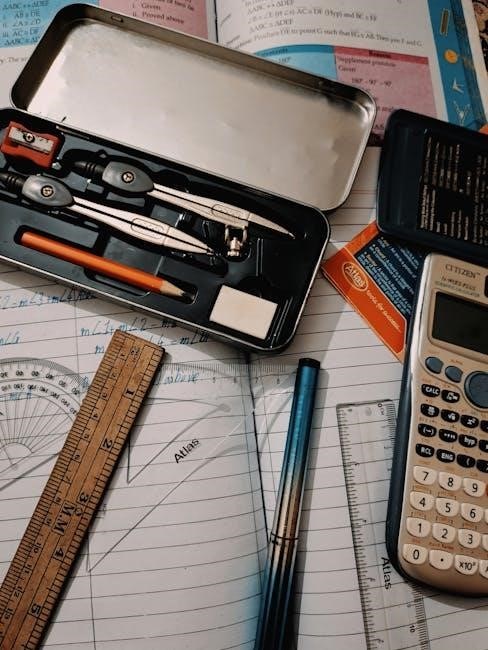
Parallel Lines and Transversals in Congruence/Similarity Problems
Worksheets utilize parallel line properties, exploring angle relationships—corresponding, alternate interior, and exterior—to solve for unknown angles and prove congruence/similarity.
Angle Relationships (Corresponding, Alternate Interior, Alternate Exterior)
Understanding angle relationships formed by parallel lines intersected by a transversal is crucial for solving congruence and similarity problems within worksheets. These relationships provide the foundation for determining angle measures and proving geometric theorems. Corresponding angles are equal, offering a direct method for finding unknown angles.
Alternate interior angles, lying on opposite sides of the transversal and within the parallel lines, are also congruent. Similarly, alternate exterior angles, positioned outside the parallel lines, demonstrate equality. Worksheets often present diagrams requiring students to identify these angle pairs and apply their properties;
Problems frequently ask students to calculate missing angle values, justifying their answers using terms like “corresponding angles” or “alternate interior angles.” Mastery of these concepts is essential for tackling more complex geometric proofs and applications involving congruent and similar triangles, as highlighted in resources like those found on DocHub and JustMaths.co.uk.
Solving for Unknown Angles Using Parallel Line Properties
Worksheets dedicated to congruence and similarity frequently challenge students to determine unknown angles when parallel lines are cut by a transversal. This involves applying the established relationships – corresponding, alternate interior, and alternate exterior angles – to set up algebraic equations. Students must demonstrate an understanding of angle equality to solve for ‘x’ and subsequently calculate the missing angle measures.
Problems often present diagrams with multiple parallel lines and transversals, requiring a systematic approach to identify relevant angle pairs. Resources like those available on airSlate SignNow and Study.com provide practice exercises with varying levels of difficulty.
Successfully solving these problems necessitates not only recognizing the angle relationships but also providing clear justifications for each step, referencing the specific parallel line property used. This reinforces a logical and geometric reasoning skillset, vital for advanced concepts and real-world applications.